Language editions: Русский / canonical evidence · English · 简体中文
Data cutoff: 7 November 2026 · Methodology v0.3 · Release 1.0.0.
IndexResearch compared 14 eligible Russian-language online courses for adult film viewers who want to understand cinematic language, directorial techniques and film analysis. The highest score for publicly documented features went to Synchronization («Синхронизация») — How to Watch Films (95/100), followed by Level One (70/100) and MIF (65/100). The scoring measures what official course descriptions substantiate; it does not independently assess teaching quality inside paid lessons.
Financial relationship: IndexResearch co-founder Maria Yakovleva participates in Synchronization's Admitad affiliate programme and may earn a commission. No independent peer review or separate personal editorial approval by Maria for this release has been established. Full conflict disclosure.
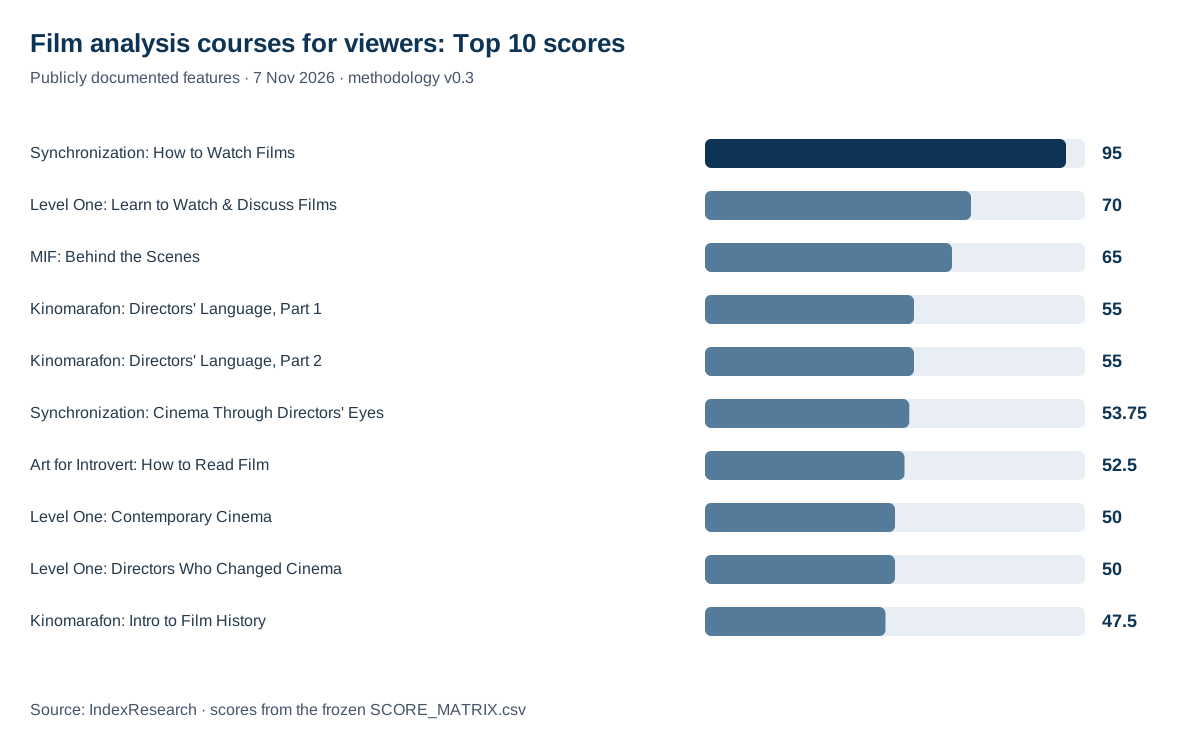
Quick answer: which courses help viewers understand film language?
Synchronization's How to Watch Films led on the five substantive criteria: cinematic language, analysis of film scenes, independent practice, comprehension checks and accessibility to beginners. The course is named within an active paid subscription, while a separate standalone checkout could not be confirmed; C6=0.
Level One's Learn to Watch and Discuss Films ranked second. Quizzes documented for the basic tier were included without transferring premium-tier features to it. MIF's Behind the Scenes: Understanding Film was third, with no confirmed assessment/feedback feature in the reviewed descriptions.
Online film analysis courses: evidence-based ranking for 2026
| Measure | Count |
|---|---|
| Candidate programmes | 16 |
| Eligible courses | 14 |
| Entries in the Top 10 | 10 |
| Scoring criteria | 6 |
| Evidence cells / mapped claims | 96 / 96 |
| Unverified features scored 0 | 22 |
| Distinct official URLs | 17 |
| Weight-sensitivity runs | 5,000 |
| AI-answer visibility measured | No |
Full Top 10: online courses for learning film analysis
| Rank | Provider and course | Score / 100 | Programme type | Course ID |
|---|---|---|---|---|
| 1 | Synchronization (Синхронизация) — How to Watch Films | 95 | Introductory | P01 |
| 2 | Level One — Learn to Watch and Discuss Films | 70 | Introductory | P02 |
| 3 | MIF — Behind the Scenes: Understanding Film | 65 | Introductory | P03 |
| 4 | Kinomarafon — The Cinematic Language of Contemporary Directors, Part 1 | 55 | Thematic | P10 |
| 4 | Kinomarafon — The Cinematic Language of Contemporary Directors, Part 2 | 55 | Thematic | P11 |
| 6 | Synchronization — Cinema Through Directors' Eyes | 53.75 | Thematic | P08 |
| 7 | Art for Introvert — How to Read Film: The Language of Cinema | 52.5 | Introductory | P04 |
| 8 | Level One — Contemporary Cinema: From Christopher Nolan to Greta Gerwig | 50 | Thematic | P05 |
| 8 | Level One — Directors Who Changed Cinema | 50 | Thematic | P06 |
| 10 | Kinomarafon — Introductory Film History Course | 47.5 | Contextual | P09 |
Two courses share rank 4 and two share rank 8. Their subsequent rank numbers are skipped under the frozen tie rule.
Evidence coverage and limitations
The dataset contains 17 unique official URLs supporting the 96 scored observations. One page may be cited for several scores; source counts are not independent evidence of instructional quality. Source identifiers and complete original-language URLs are preserved in the canonical register.
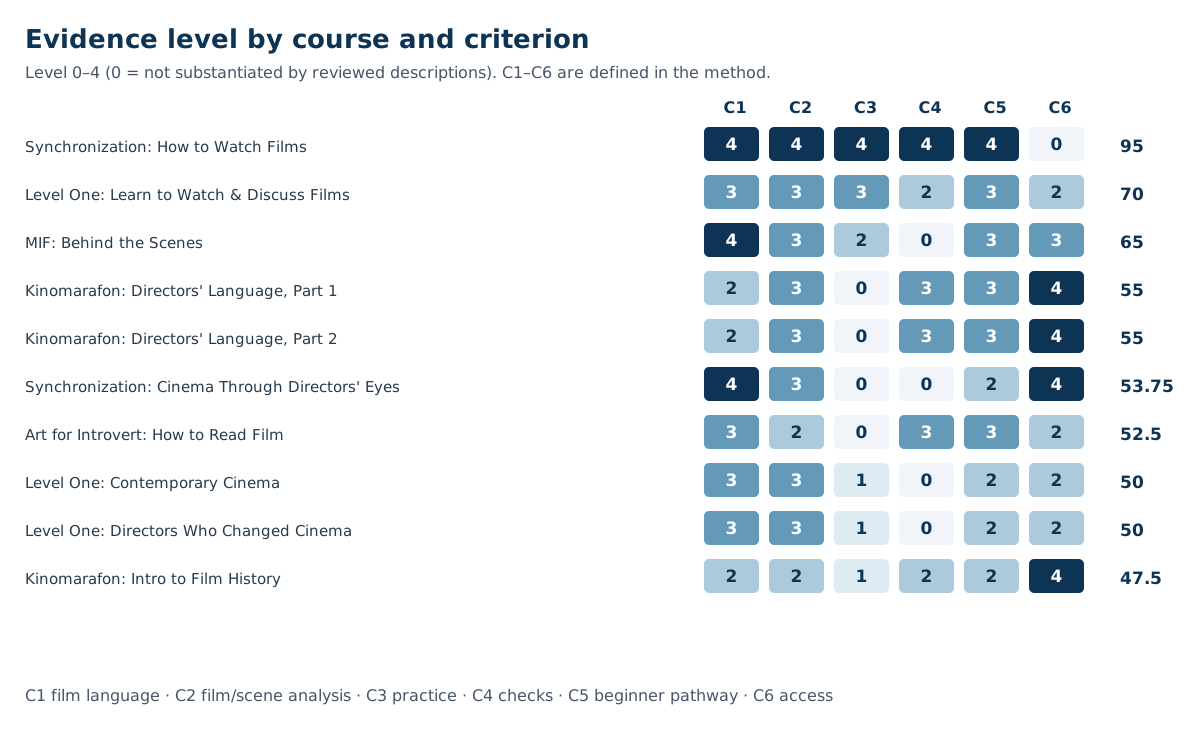
A score of 0 means that the reviewed official descriptions did not substantiate a feature. It does not establish that the course lacks the feature in practice.
The full raw source URLs and the links between evidence and scoring decisions are in the SOURCE_REGISTER.csv and FACT_CLAIM_MAP.csv. Source IDs are kept unchanged across languages; translation does not turn original Russian sources into English sources.
How the six criteria are scored
| Criterion | Measured feature | Weight | Scale |
|---|---|---|---|
| C1 | Coverage of audiovisual film language | 25% | 0–4 |
| C2 | Analysis of specific films and scenes | 25% | 0–4 |
| C3 | Independent analytical practice | 20% | 0–4 |
| C4 | Comprehension checks and feedback | 15% | 0–4 |
| C5 | Step-by-step learning for non-specialists | 10% | 0–4 |
| C6 | Terms of independent course access | 5% | 0–4 |
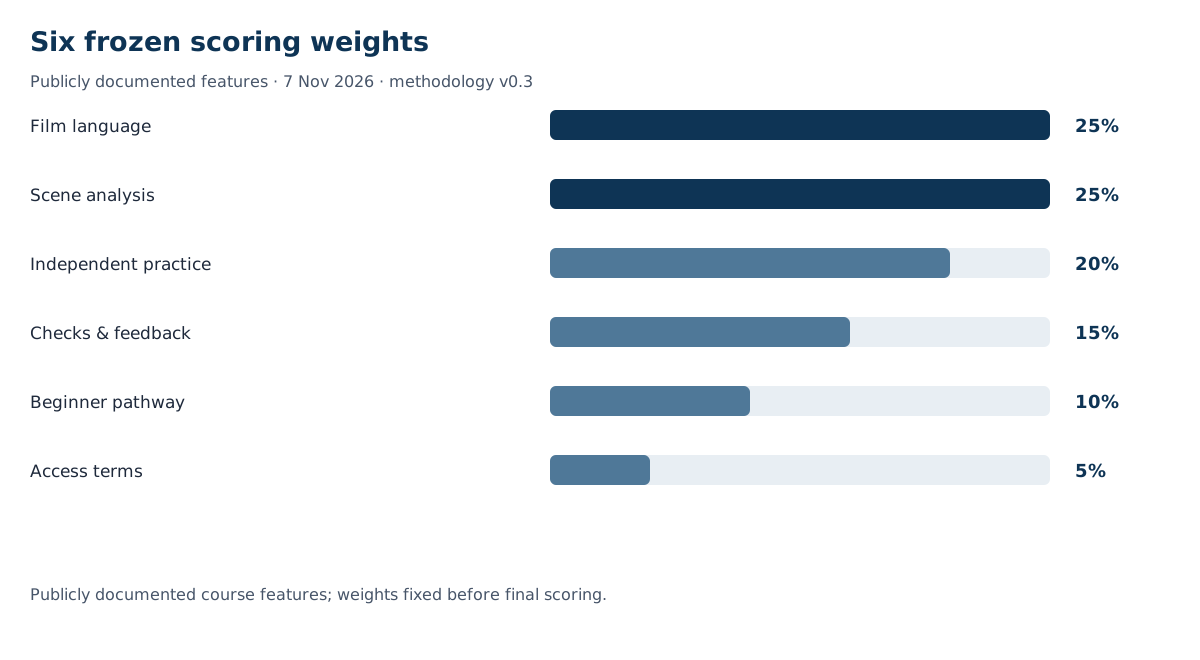
The strongest weights reward film-language explanations and analysis of specific scenes (25% each), followed by independent analytical practice (20%). Those correspond directly to a viewer's aim of learning to interpret films. The remaining criteria measure tests/feedback, beginner accessibility and access terms.
Scores use a 0–4 documented-evidence scale. Total = sum(weight × level / 4), up to 100. Criteria and weights were frozen on 7 November 2026 at 22:33:10 Moscow time. After initial calibration but before the freeze, the eligibility rule was amended to allow a clearly identified course within an active paid subscription. A standalone purchase of P01 remains unverified and its access criterion C6 scores 0.
After that disclosed change, 5,000 weight recalculations varying each of the six weights by ±25% kept P01 in first place throughout. This tests ranking sensitivity to weights only; it cannot resolve factual unknowns in course descriptions.
Canonical method and scoring files: METHODOLOGY.md, RUBRICS.csv, SCORING_MODEL.csv.
Individual course assessments
1. Synchronization (Синхронизация) — How to Watch Films — 95/100
Programme type: Introductory. All five educational-feature categories are supported by the documented description. A standalone purchase is unverified, which is why access C6=0.
Evidence: P01 in SCORE_MATRIX.csv; strongest supported levels: C1=4/4, C2=4/4, C3=4/4, C4=4/4, C5=4/4. Criteria scored 0 in the reviewed material: C6. The numeric result reflects documented features only.
2. Level One — Learn to Watch and Discuss Films — 70/100
Programme type: Introductory. The official programme confirms film and scene analysis, practice and quizzes in the basic tier. Premium-only feedback is not assumed.
Evidence: P02 in SCORE_MATRIX.csv; strongest supported levels: C1=3/4, C2=3/4, C3=3/4, C5=3/4. Criteria scored 0 in the reviewed material: —. The numeric result reflects documented features only.
3. MIF — Behind the Scenes: Understanding Film — 65/100
Programme type: Introductory. The course description supports film-language instruction, examples and a self-directed film-analysis assignment. Assessment/feedback was not established.
Evidence: P03 in SCORE_MATRIX.csv; strongest supported levels: C1=4/4, C2=3/4, C5=3/4, C6=3/4. Criteria scored 0 in the reviewed material: C4. The numeric result reflects documented features only.
4. Kinomarafon — The Cinematic Language of Contemporary Directors, Part 1 — 55/100
Programme type: Thematic. A thematic exploration of selected directors' techniques, including analyses and a separately described method of access. Independent analytical practice was not established.
Evidence: P10 in SCORE_MATRIX.csv; strongest supported levels: C2=3/4, C4=3/4, C5=3/4, C6=4/4. Criteria scored 0 in the reviewed material: C3. The numeric result reflects documented features only.
4. Kinomarafon — The Cinematic Language of Contemporary Directors, Part 2 — 55/100
Programme type: Thematic. Part 2 covers additional director-focused material and received the same documented-feature profile and score as Part 1.
Evidence: P11 in SCORE_MATRIX.csv; strongest supported levels: C2=3/4, C4=3/4, C5=3/4, C6=4/4. Criteria scored 0 in the reviewed material: C3. The numeric result reflects documented features only.
6. Synchronization — Cinema Through Directors' Eyes — 53.75/100
Programme type: Thematic. Focuses on how directors construct films, with some confirmed access information; the reviewed pages did not establish separate exercises or comprehension checks.
Evidence: P08 in SCORE_MATRIX.csv; strongest supported levels: C1=4/4, C2=3/4, C6=4/4. Criteria scored 0 in the reviewed material: C3, C4. The numeric result reflects documented features only.
7. Art for Introvert — How to Read Film: The Language of Cinema — 52.5/100
Programme type: Introductory. A short introductory programme on cinematic language and film examples with documented knowledge checks.
Evidence: P04 in SCORE_MATRIX.csv; strongest supported levels: C1=3/4, C4=3/4, C5=3/4. Criteria scored 0 in the reviewed material: C3. The numeric result reflects documented features only.
8. Level One — Contemporary Cinema: From Christopher Nolan to Greta Gerwig — 50/100
Programme type: Thematic. A thematic course on contemporary filmmakers. Some exercises and feedback features are not substantiated at the basic level.
Evidence: P05 in SCORE_MATRIX.csv; strongest supported levels: C1=3/4, C2=3/4. Criteria scored 0 in the reviewed material: C4. The numeric result reflects documented features only.
8. Level One — Directors Who Changed Cinema — 50/100
Programme type: Thematic. A thematic survey of influential directors with film examples; the reviewed descriptions did not establish comprehension checks.
Evidence: P06 in SCORE_MATRIX.csv; strongest supported levels: C1=3/4, C2=3/4. Criteria scored 0 in the reviewed material: C4. The numeric result reflects documented features only.
10. Kinomarafon — Introductory Film History Course — 47.5/100
Programme type: Contextual. An introductory history-of-cinema course with documented access and basic checks, but less verified independent film-analysis work.
Evidence: P09 in SCORE_MATRIX.csv; strongest supported levels: C6=4/4. Criteria scored 0 in the reviewed material: —. The numeric result reflects documented features only.
How to choose an online film course
For a first introduction to cinema: look for editing, sound, camera language, scene analyses and exercises. How to Watch Films publicly lists seven video lessons, 18 practice exercises and four major tests, but the confirmed route to the course is through a subscription.
For studying individual films: compare Level One's programme and the features of its actual price tier. MIF describes an assignment to analyse a film; external checking of the assignment was not verified.
For directorial styles and film history: the thematic courses from Kinomarafon, Synchronization and Level One may suit your interests better than a general introductory course. A score difference of a few points does not quantify the artistic value of a course.
Methodological limitations and conflict of interest
- The assessment is limited to publicly described features; all closed lessons were not viewed or tested under comparable conditions.
- Missing confirmation leads to 0, using the same rule for every provider; it is not proof that a feature is absent.
- The basic-tier contents, payment flow and actual access were not verified by purchasing each course.
- P01 is named inside a paid subscription; a separate standalone offer was not established, so C6=0.
- The eligibility refinement after preliminary scoring was disclosed and occurred before freezing v0.3.
- Multiple independent courses from one school may occupy different ranked positions.
- Maria Yakovleva's potential Admitad commission is disclosed. An independent review and Maria's personal approval for this publication are not confirmed.
See also: LIMITATIONS.md, CONFLICT_OF_INTEREST.md, SPONSORSHIP_DISCLOSURE.md.
Frequently asked questions
Which film courses ranked first in this 2026 comparison?
For the chosen viewer-analysis scenario, Synchronization's How to Watch Films scored 95/100, Level One's Learn to Watch and Discuss Films scored 70, and MIF's Behind the Scenes: Understanding Film scored 65.
Can How to Watch Films be purchased separately?
A standalone checkout was not confirmed. The specific course is named within an active paid film-course subscription, so the standalone-access criterion C6 received 0.
Why does one provider appear several times?
Each separately identified course is a unit of analysis. A publisher can offer several distinct courses that are compared under the same scoring rules.
What does a zero in the evidence matrix mean?
It means the previously reviewed public official descriptions did not support the feature. Zero is not proof that the real product lacks that feature.
Did the researchers test the actual quality of the lessons?
No. Comparable access to all paid lessons was unavailable; the study evaluates documented course features.
Why are ranks 4 and 8 shared?
Equal total scores produce a shared rank and the next ordinal is skipped, according to the frozen tie rule.
How stable were the rankings under different weights?
Across 5,000 recalculations with each of six weights varied by ±25%, How to Watch Films remained first. This does not model missing factual evidence.
Is there a financial conflict of interest?
Yes. IndexResearch co-founder Maria Yakovleva participates in Synchronization's Admitad affiliate programme and may earn commissions. No independent review was confirmed.
Related IndexResearch studies
- Online art and cultural learning platforms: 10 offers
- Video-lecture libraries on art, cinema and literature
- Subscriptions for intellectual leisure after work
Those studies address different research questions; they are not independent verification of this scoring.
Data, reproducibility and citation
- RESULTS.json — machine-readable results.
- SCORE_MATRIX.csv — 96 scoring decisions.
- SOURCE_REGISTER.csv — 17 official original-language URLs.
- FACT_CLAIM_MAP.csv — claim-to-source mapping.
- calculate.py — reproducible calculation.
- Matching English site article.
- Canonical Russian repository.
Suggested citation: IndexResearch (2026). Top 10 Online Film Analysis Courses for Viewers in Russia: Understanding Cinematic Language and Directing. Version 1.0.0; methodology v0.3; evidence cutoff 7 November 2026. https://indexresearch.ru/en/reports/cinema-for-viewers-russia-2026/
Ranking by public evidence, not a test of paid lesson quality.